


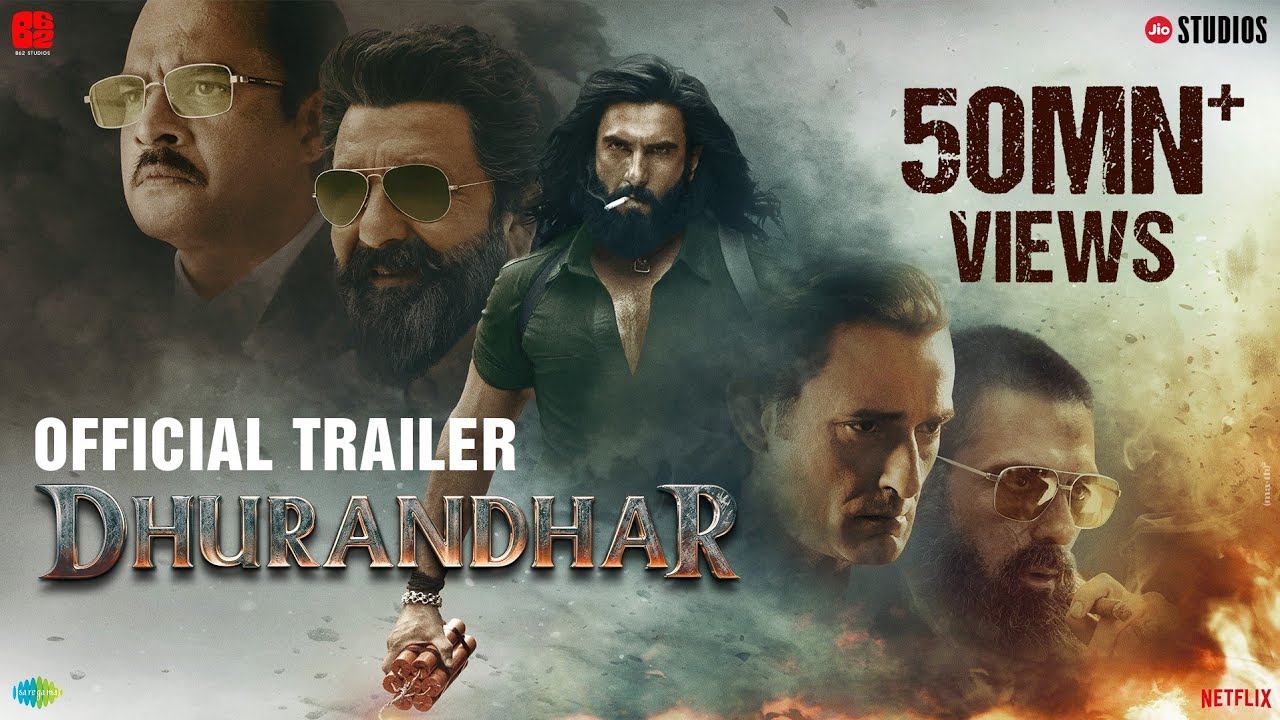
Dhurandhar Review: Ranveer Singh’s Controlled Fury Meets Akshaye Khanna’s Cold Intelligence in a Film That Refuses to Play Safe
By Rasesh Patell, Founder & Chief Critic, CharotarDaily.com
Some films announce themselves with noise. Others arrive with silence and then tighten their grip slowly. Dhurandhar does something more dangerous—it waits, watches, and then strikes with calculated force.
As someone who has watched Hindi cinema evolve from broad-stroke heroism to morally conflicted protagonists, I approached Dhurandhar not as a fan, but as a critic searching for intent. This is not a film interested in crowd-pleasing shortcuts. It wants to be dissected. And that, in itself, makes it worthy of serious attention.
This is not a plot summary. What follows is a critical deconstruction—of direction, cinematography, screenplay, and, most crucially, performances by Ranveer Singh, Akshaye Khanna, and Arjun Rampal—to determine whether Dhurandhar truly earns its gravitas or merely performs it.
Direction: A Film That Believes in Pressure, Not Spectacle
The director of Dhurandhar makes one thing clear from the outset: this is not a “moment film.” There are no entry scenes designed for whistles, no indulgent slow-motion hero walks. Instead, the film is built on pressure—emotional, psychological, and moral.
The direction relies heavily on containment. Scenes often begin in tight spaces—rooms, corridors, interiors—before gradually opening out, mirroring the protagonist’s expanding influence. A standout sequence midway through the film places Ranveer Singh’s character in a morally compromising negotiation. The camera never cuts away when it would be comfortable to do so. We are forced to sit with the tension.
This approach works because the director understands that power is most frightening when it is quiet. However, the film occasionally overcommits to its seriousness. By denying itself moments of narrative release, it risks emotional fatigue in the latter half. Still, this is a filmmaker who knows exactly what kind of film he is making—and refuses to dilute it.
Ranveer Singh: The Most Restrained Performance of His Career
Ranveer Singh has built a career on volume—explosive energy, flamboyant physicality, and theatrical transformation. Dhurandhar is fascinating precisely because it asks him to do the opposite.
Here, Singh plays a man whose anger is compressed, not displayed. His voice is lower, his movements economical, his expressions often unreadable. This is not the Ranveer Singh of Padmaavat or Gully Boy. This is a performance rooted in internal conflict rather than external expression.
One early scene crystallises this shift. Faced with humiliation, Singh’s character does not react immediately. The pause—just a second too long—is devastating. It tells us everything about a man learning when to strike and when to wait.
What impresses most is Singh’s refusal to chase sympathy. His character is not designed to be liked. He is designed to be understood. This level of restraint signals a mature phase in Singh’s career—one where craft overtakes charisma.
Akshaye Khanna: Intelligence as a Weapon
If Ranveer Singh provides the film’s emotional weight, Akshaye Khanna supplies its intellectual menace.
Khanna has long excelled at playing men whose power lies in their minds rather than their fists, and Dhurandhar uses this strength brilliantly. His character operates within systems—law, bureaucracy, influence—and Khanna portrays this with chilling precision.
There is a scene late in the film where Khanna delivers a monologue that could have easily tipped into melodrama. Instead, he underplays it, almost conversationally, making it far more threatening. His eyes do most of the work. You never doubt that this is a man who has already calculated three outcomes ahead.
In the dynamic between Singh and Khanna, Dhurandhar finds its sharpest edge. Their confrontations are not loud—they are strategic. This is not good versus evil; it is force versus foresight.
Arjun Rampal: A Study in Controlled Physicality
Arjun Rampal’s role in Dhurandhar is deceptively simple—and that’s precisely why it works.
Rampal plays a character whose authority is established through presence, not exposition. He doesn’t speak much, but when he does, the room listens. Physically imposing without being cartoonish, Rampal brings a sense of inevitability to his scenes.
What stands out is his ability to convey loyalty and threat simultaneously. In a key confrontation, Rampal’s silence becomes more intimidating than dialogue. This is a reminder of how effective he can be when cast with clarity and restraint.
Cinematography: Grit Without Glorification
Visually, Dhurandhar is unapologetically grounded. The camera favours natural light, muted colours, and lived-in textures. There is a deliberate avoidance of glossy aesthetics. Violence, when it occurs, is abrupt and uncomfortable—not stylised.
One particularly effective technique is the use of static frames during moments of emotional intensity. Instead of following the action, the camera often refuses to move, forcing the audience to confront consequences rather than spectacle.
This choice aligns perfectly with the film’s thematic core: power corrodes quietly.
Screenplay: Sharp Themes, Occasional Overstatement
The screenplay of Dhurandhar is intellectually ambitious. It explores moral compromise, institutional decay, and personal ambition with seriousness. Several dialogues are incisive and memorable.
However, the script sometimes mistrusts its own intelligence. There are moments—especially in the second half—where themes are reiterated rather than deepened. The film could have benefited from tighter editing and fewer explanatory exchanges.
That said, the writing never becomes lazy. Even at its weakest, it remains engaged with ideas rather than clichés.
Genre Context: A Serious Entry in Contemporary Hindi Cinema
Within the Hindi action-drama genre, Dhurandhar aligns more with adult, politically conscious storytelling than mass entertainment. It may not deliver instant gratification, but it offers something rarer—lasting impact.
Compared to formula-driven releases, this film takes risks. Not all of them pay off, but the attempt itself deserves respect.
Final Verdict
Dhurandhar is not a perfect film—but it is a serious one, and that matters.
Anchored by Ranveer Singh’s most disciplined performance to date, elevated by Akshaye Khanna’s cerebral menace, and grounded by Arjun Rampal’s imposing presence, the film succeeds more often than it stumbles.
Its flaws stem from excess ambition, not lack of vision.
Rating: 3.5 / 5
Who Should Watch This Film?
-
Viewers who appreciate performance-driven Hindi cinema
-
Audiences tired of formulaic action films
-
Fans of Ranveer Singh looking for his most mature work
-
Anyone interested in films that provoke thought, not just applause

 Get ready for an epic adventure through the realms of cinema and gaming! Our platform is your ultimate destination for unbiased and insightful reviews. From blockbuster movies to indie gems, we've got you covered. Discover the latest gaming trends, explore new worlds, and level up your entertainment experience. Join us as we dissect plots, analyze characters, and test the limits of virtual reality.